How To Price Handmade Items to Sell (Without Underselling Yourself)
.webp)
You know that moment. Someone picks up your earrings at a craft fair, flips over the little price tag, and goes, "Oh... fifteen dollars?" Like you just tried to sell them a used napkin.
Meanwhile you spent three hours on those earrings. You sourced the beads. You burned yourself twice with the wire. And now you're standing there half-smiling, half-wanting to explain the entire supply chain to a stranger who just wants earrings that match her jacket.
If that's happened to you, you're not bad at pricing. You just never learned how, because nobody teaches this. Most makers price out of guilt or guesswork, not math. And that's the thing we're going to fix.
Key Takeaways
- Learn why guessing your prices is quietly costing you money, and how to fix it for good
- Break down exactly what goes into a fair price, from materials to your own hourly rate
- Use a simple calculator to turn your costs into a price that actually makes sense
- Spot the common pricing mistakes that keep makers underpaid without them even realizing it
Why Handmade Pricing Goes Wrong So Often
There are basically two ways makers mess this up. The first is pricing too low because charging money for something you love feels weird. Like you're not allowed to profit from a thing that also happens to be fun.
But the truth is that enjoying your craft doesn't make your time free. A therapist enjoys helping people and still charges by the hour.
The second way is pricing randomly. You saw a similar item on Etsy for $22, so you picked $20 because it felt competitive. Except you have no idea what that other seller's costs actually are.
Maybe they buy materials in bulk. Maybe they're losing money too and just don't know it yet. Copying a stranger's price tag isn't a pricing strategy because it's a coin flip.
And then there's the comparison trap, standing your handmade mug next to a $6 one at Target and feeling like you're overcharging. You're not. A machine made that mug in a factory that never sleeps. You aren't competing with that.
What Actually Goes Into Your Price
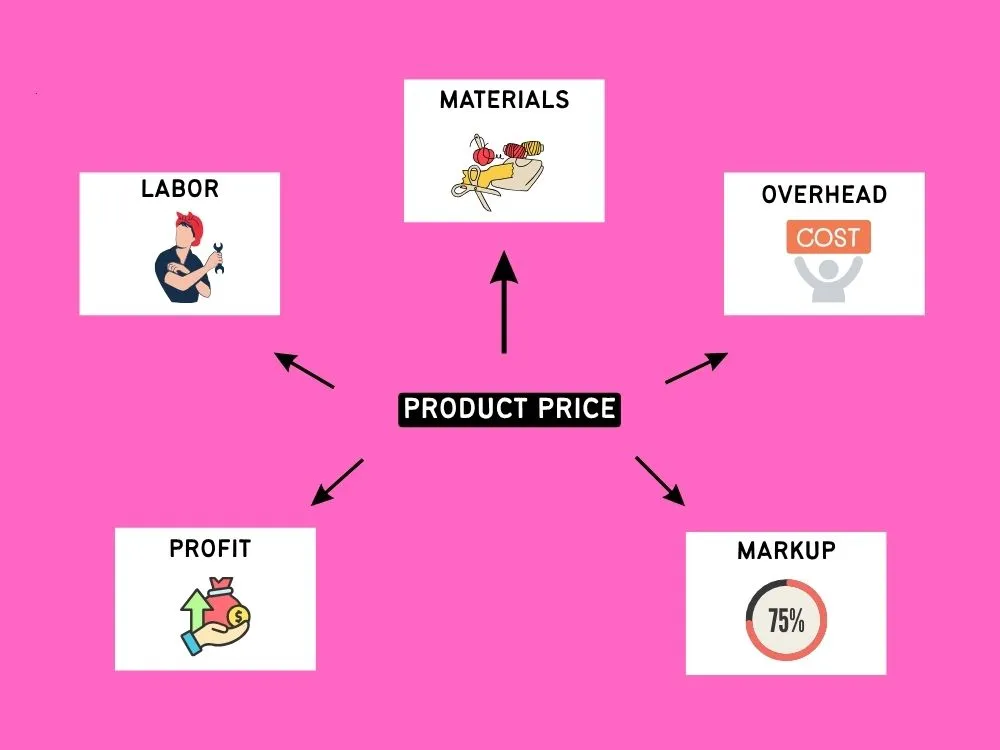
Here's where we get concrete, because vague advice like "price it fairly" helps nobody. A real handmade price is built from five pieces. Miss even one, and you're quietly working for less than you think.
1. Materials:
This is more than the obvious stuff. For example, it's the clay but also the jump rings, the backing cards, the tissue paper you wrap it in, even the little sticker that says handmade with love.
All of it costs something, and all of it needs to be counted, not estimated from memory two months later.
2. Labor:
This is the one makers skip the most without knowing. Your time is worth something, even if you're half-watching a show while you sand something down.
Pick an hourly rate that isn't insulting to yourself, even $15 or $20 an hour to start. Track your hours honestly and round up if anything, not down.
3. Overhead:
These are the costs that don't attach themselves to one single item but are still very real. Electricity for your sewing machine. That craft fair booth fee. Your Etsy listing fees.
The Canva subscription you use for your product photos. None of this feels like the product but it's part of what keeps your shop alive, so it belongs in the price.
4. Profit:
This part trips people up because it sounds greedy but it's not. Profit is important because it lets you reinvest or buy more materials. With good profits, you can replace a tool that finally died and keep your business running instead of slowly bleeding out.
A reasonable starting point is somewhere between 5% and 30% based on your product and your market. You can adjust as you get more comfortable.
5. Markup:
Think of markup as your shop's shock absorber. It's the cushion that covers the stuff you can't always predict. A discount code you ran, a shipping mistake, a slow month, etc.
If wholesale is ever part of your plan, you'll want your markup high enough to absorb that, generally at least 100%. If you're only selling retail, you have a little more room to breathe. But you still want enough padding that a bad week doesn't wipe out your margin.
Most handmade sellers land somewhere between 60% and 100% markup, and that's a completely normal range to sit in.
Put together, it looks like this
| Materials + Labor + Overhead + Profit + Markup = Price |
Nothing complicated. Just five honest numbers instead of one guess.
Do the Math Without Doing It Manually
Normally I'd say grab a calculator and start doing the math yourself. But that's how you end up with a spreadsheet you made one afternoon and haven't opened since.
So here's a tool that does the job for you. Toss in what you spent on materials, how many hours you sank into it, what your time's worth per hour, and a rough guess at overhead and profit. It'll hand you back a price that actually reflects your work, not just a random number you pulled out of thin air.
Let's say you make a hand-poured candle. Materials run you about $4. It takes 45 minutes to make and you've decided your time is worth $18 an hour. So that's around $13.50 in labor.
Add a little overhead, maybe $1.50 for jars, labels, and your share of electricity. That's roughly $19 before profit and markup even enter the picture.
Once you add a reasonable profit margin and enough markup to give yourself breathing room, you land somewhere closer to $30 to $35 for a candle that, on the surface, "just costs a few dollars in wax." That gap isn't overcharging. That gap is the actual cost of your time and your risk as a small business.
Pricing Mistakes That Quietly Cost You
A few habits worth watching for because they sneak in without you noticing:
- Matching someone else's price instead of your own numbers. Their costs aren't your costs. Their rent, other running costs, their sourcing, their hourly rate, none of it is yours.
- Treating your time as free because you enjoy it. Enjoyment and value aren't opposites. You can love something and still get paid fairly for it.
- Discounting too early because a sale feels good. A 20% off sticker feels great for about five minutes and can quietly erode the value people place on your work.
- Never revisiting your prices. Material costs creep up. Shipping goes up. If your prices haven't moved in two years, you're basically giving yourself a pay cut every time a supplier raises theirs.
Wrapping Up
Pricing handmade products fairly is important and it doesn't mean squeezing customers for every dollar. It's about staying in business long enough to keep making what you love. Good work deserves a real price tag. So here's your one job. Before your next item goes up for sale, run it through the calculator instead of guessing.
FAQs
Q1: Should I charge for my time even if I enjoy making things?
Yes, absolutely. Enjoying your craft doesn't make your time free. A hairstylist loves their job too and they still charge by the hour for every single client.
Q2: What's the difference between wholesale and retail pricing?
Wholesale is what you'd charge a store buying in bulk. Retail is what individual customers pay you directly. Retail should always run higher to protect your profit margin.
Explore Related posts
https://smarttoolsai.com/post/how-to-start-dropshipping
https://smarttoolsai.com/post/how-to-start-a-candle-making-business
https://smarttoolsai.com/post/the-4ps-of-marketing-game-changer-for-your-business-success