How to Calculate Break-Even Point for a Small Business
.webp)
There's a moment every small business owner hits, usually somewhere around month three or four, where they start wondering if they're actually making money or just staying busy.
Sales are happening. Orders are coming in. But does any of that money actually cover what it takes to keep the business running? That question has an answer and it's called your break-even point.
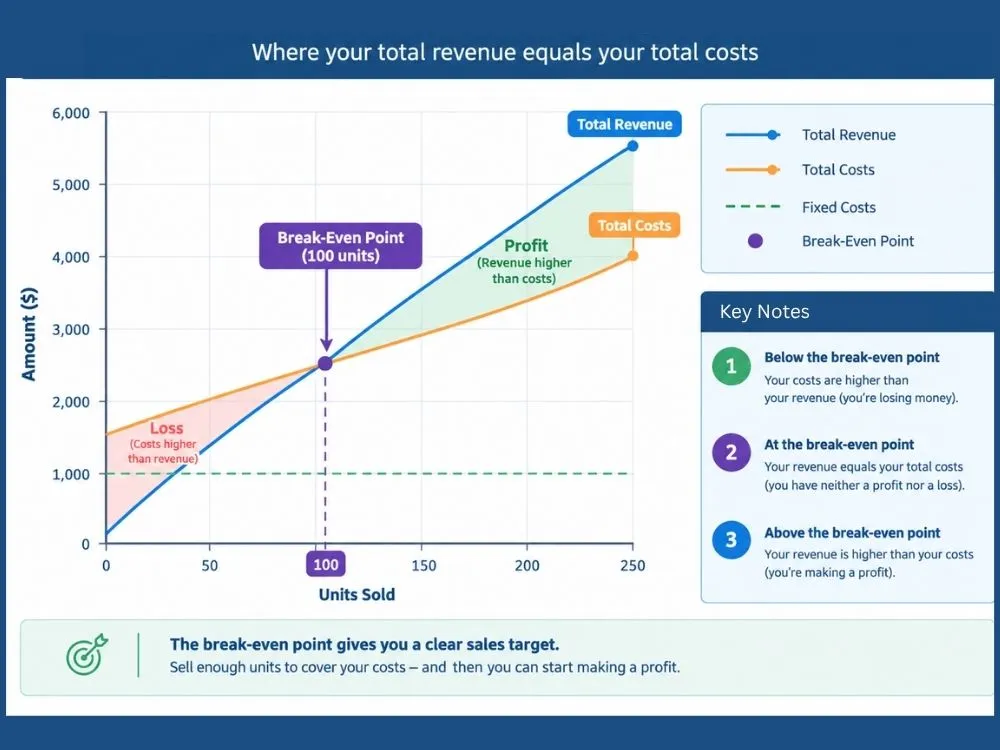
It shows you the exact sales figure you need to hit before your revenue finally covers everything you're spending. Below that number, you're operating at a loss. Above it, you're finally into profit territory.
We've built a calculator to help you find your number fast and it's coming up in just a bit. First, let's walk through what break-even point actually means and how it's calculated because understanding the pieces makes the calculator a lot more useful.
Key Takeaways
- Learn what your break-even point means and why hitting it isn't the same as turning a profit
- Break down your fixed and variable costs to see exactly what it takes to cover your business
- Use a simple calculator to find your break-even units and revenue without doing the math yourself
- Spot the common mistakes that throw off a break-even calculation and leave owners chasing the wrong number
What Is the Break-Even Point?
It's the precise level of sales, whether measured in units or dollars, at which your revenue and your total costs land on the same number. No more or less. Past that line is where profit actually starts.
A few terms come up constantly in this kind of math, so let's define them plainly.
- Fixed costs: Expenses that stay the same no matter how much you sell. Rent is the classic example.
- Variable costs: Expenses that rise and fall depending on how much you produce or sell.
- Selling price: What you charge per unit of whatever you're selling.
- Contribution margin: How much of each sale is left over after variable costs before fixed costs even come into play.
- Break-even point: The number of units or the dollar amount where those numbers finally balance out.
Once you understand how these five pieces relate to each other, the formula itself is almost too easy.
What Makes Break-Even Analysis Worth Doing for a Small Business
This isn't just a math exercise for accountants. Knowing your break-even point actually changes how you run your business day to day.
- It gives you a real sales target instead of a vague hope that things are going okay.
- It helps you make smarter pricing decisions, since you'll know exactly how price changes shift your number.
- It's essential when you're planning a new product, since you can test whether it's even worth launching before you spend money on it.
- It helps you understand your business risk, since a low break-even point means less pressure to hit huge sales numbers just to stay afloat.
- It lets you evaluate whether a product is commercially viable before you fall in love with an idea that never quite pays for itself.
- It gives you a framework for planning ahead when your costs or your pricing are about to change.
Basically, this one number touches almost every major decision you'll make running a small business.
Break-Even Point Formula
Here's the core formula.
| Break-Even Units = Fixed Costs ÷ (Selling Price Per Unit - Variable Cost Per Unit) |
That part in the parentheses has a name of its own and it matters enough to call out separately.
| Contribution Margin = Selling Price - Variable Cost Per Unit |
Think of your contribution margin as the slice of each sale that goes toward paying off your fixed costs. The higher that figure climbs, the sooner you'll reach profitable territory.
How to Calculate the Break-Even Point
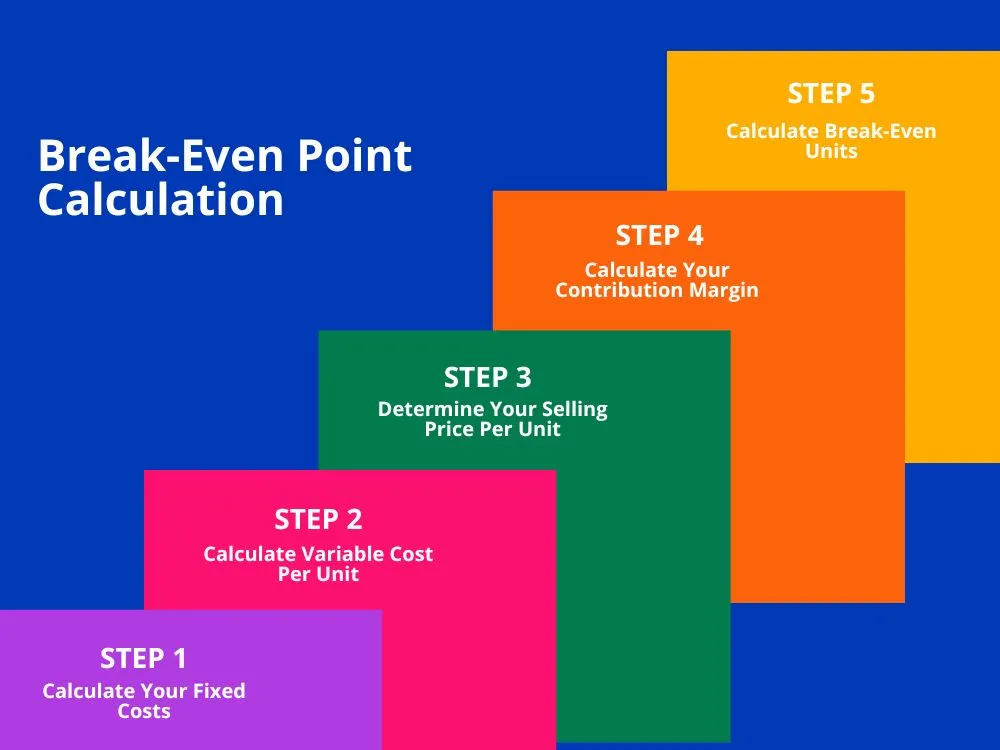
Let's break this down into steps you can actually follow with your own numbers.
Step 1. Calculate Your Fixed Costs
Add up everything you pay regardless of how much you sell in a given month. Common examples include
- Rent
- Insurance
- Salaries that don't change based on production
- Software subscriptions
- Business licenses
- Any other recurring expense that stays the same no matter what
Step 2. Calculate Variable Cost Per Unit
Next, work out how much a single unit actually costs you to produce. This usually includes
- Materials
- Packaging
- Other per-unit production costs
- Transaction costs tied to each sale
Step 3. Determine Your Selling Price Per Unit
This part seems obvious but there's a detail that trips people up. Your selling price needs to sit above your variable cost per unit. Otherwise, the whole calculation stops making sense. If you're selling below your variable cost, no volume of sales will ever get you to break even.
Step 4. Calculate Your Contribution Margin
Start with your selling price, then knock off the variable cost per unit.
| Selling Price - Variable Cost = Contribution Margin |
Step 5. Calculate Break-Even Units
Now plug everything into the full formula from earlier.
| Break-Even Units = Fixed Costs ÷ Contribution Margin |
Whatever number comes out is how many units you need to sell before you've covered your costs completely.
The calculator asks for three inputs. Three numbers go in like what you pay regardless of sales, what each unit costs to produce, and what you charge for it.
Three numbers come out like the cushion left in each sale once variable costs are paid, the sales volume needed to get you to zero, and that same milestone shown in dollars instead of units.
Try running your own numbers through it. Seeing your real break-even number, instead of just estimating it tends to shift how people think about their pricing pretty quickly.
How to Calculate Break-Even Sales Revenue
Sometimes it's more useful to think in dollars rather than units, especially if you sell a variety of products at different prices.
| Break-Even Sales Revenue = Break-Even Units × Selling Price Per Unit |
Imagine your break-even number lands at 100 units, priced at $35 each.
100 × $35 = $3,500
That means once you've brought in $3,500 in sales, you've officially covered your costs. Everything past that is where profit begins.
Fixed Costs vs Variable Costs
Since these two categories are the foundation of the whole calculation, it helps to see them side by side.
| Fixed Costs | Variable Costs |
|---|---|
| Rent | Materials |
| Insurance | Packaging per unit |
| Software subscriptions | Per unit production costs |
| Business licenses | Some transaction fees |
| Certain salaries | Other costs that change with sales volume |
Worth noting, some expenses aren't purely one or the other. A phone bill might have a flat base rate plus usage charges, for example. When that happens, it's on you to split the expense into its fixed and variable parts so your calculation stays accurate.
What Happens If Your Selling Price Changes?
Your selling price has a direct ripple effect on your break-even point and it's worth understanding exactly how.
- A higher selling price increases your contribution margin.
- A bigger contribution margin means fewer units needed to reach break-even.
- A lower selling price shrinks your contribution margin.
- A smaller contribution margin means more units needed to reach break-even.
This is exactly why pricing decisions matter so much for small businesses. Even a modest price bump can noticeably reduce how many sales you need to stay profitable.
If you haven't nailed down your pricing strategy yet, that's a whole separate piece of the puzzle worth working through on its own.
What Happens If Your Costs Increase?
Costs rarely stay flat forever, so it's worth understanding how increases on either side affect your number.
- When fixed costs rise, say your rent goes up or you add a new software subscription, your break-even point rises with it. Now you've got to sell more units just to clear that higher baseline.
- When variable costs rise, say your materials get more expensive, your contribution margin shrinks. Even if your fixed costs stay exactly the same, you'll need to sell more units to make up the difference.
- Either way, the fix usually comes down to the same few levers. Raise your price, cut your costs, or accept that your break-even point has shifted and plan around the new reality.
Break-Even Point vs Profit
This part trips people up constantly, so it's worth stating plainly. At break-even, your revenue and your total costs land on the same number. That's it. You haven't made money and you haven't lost any either. You're simply even.
Profit only starts once you sell past that point. Every unit sold beyond your break-even number contributes directly to your bottom line, assuming your costs and pricing stay the same as what you used in the calculation.
So hitting your break-even point isn't the finish line. It's the starting line for actual profit.
Common Break-Even Calculation Mistakes
A handful of mistakes show up again and again and any one of them can throw your whole number off.
- Mixing up fixed and variable costs instead of classifying them correctly
- Forgetting certain costs entirely, especially small recurring ones
- Using the wrong selling price, particularly if you sell at different prices across channels
- Plugging in total variable costs rather than the cost per individual unit
- Forgetting that break-even units usually need to be rounded up, since you can't sell a fraction of a product
- Assuming reaching break-even guarantees future profitability, when it only reflects the assumptions you plugged in
- Not updating your calculation when your prices or costs change, which makes the whole number outdated fast
Catching these early keeps your break-even number honest and actually useful.
Wrapping Up
Your break-even point might sound like a dry accounting term but it's honestly one of the most useful numbers a small business owner can know. It turns vague hope into a real target and it gives you a clear read on how pricing and cost changes actually affect your bottom line. Once you know your number, every decision after that gets a whole lot clearer.
FAQs
Q1: What is a break-even point in business?
It's the exact point where your total revenue equals your total costs. Below it you're operating at a loss, and above it you're generating profit.
Q2: How do you calculate break-even point?
Take your fixed costs and divide them by your contribution margin, meaning your price minus your variable cost per unit. That tells you the units needed to break even.
Q3: What is a contribution margin?
It's the amount left over from each sale after variable costs are covered. That leftover amount goes toward paying off your fixed costs.
Q4: How Do Fixed Costs Differ From Variable Costs?
Fixed costs hold steady no matter your sales volume, think rent. Variable costs shift with production or sales, think materials.
Explore Related Posts
https://smarttoolsai.com/post/how-to-calculate-profit-margin
https://smarttoolsai.com/post/how-to-calculate-your-craft-business-profit
https://smarttoolsai.com/post/how-to-price-handmade-items-to-sell