How to Calculate Your Craft Business Profit (Includes A Free Profit Calculator)
.webp)
You just sold out at the Saturday market. Every bracelet, every hand-thrown mug is gone. Your feet hurt, your card reader is lighting up, and you're riding that high that only comes from watching strangers hand you cash for something you made with your own two hands.
Then your friend asks how much you actually made. And you freeze. Because you genuinely don't know. You know how much came in but you don't know how much you kept. Those are two very different numbers and honestly, most crafters never learn to tell them apart.
This isn't a math problem you're bad at. It's a calculation problem nobody ever taught you. By the end of this, you'll know your actual number. Not a guess. Not a vibe. A real one.
Key Takeaways
- Learn why guessing your profit is quietly draining your business, and how to get a real number finally
- Break down exactly what's eating your revenue, from materials to labor to the fees you forget about
- Use a simple calculator to turn your real costs into a profit number you can actually trust
- Spot the pricing mistakes that keep makers working for pennies without ever realizing it's happening
Why Most Crafters Get This Wrong
Pricing a handmade item is weirdly personal. You're not pricing a product. You're pricing hours of your life, your skill, the thing you stayed up late finishing. So most people price by feel instead of by math.
Maybe you looked at what other sellers on Etsy charge and matched it. Maybe you picked a number that felt fair, whatever that means. Maybe you undercharged because charging what you're actually worth felt a little greedy, like you were being too much.
Sound familiar? That's basically every crafter's origin story. The problem is, feelings don't pay your electric bill. And a business that runs on vibes instead of numbers can look busy and profitable on the outside while quietly bleeding you dry. You need the real number. Let's find it.
The Five Costs Hiding Inside Every Sale
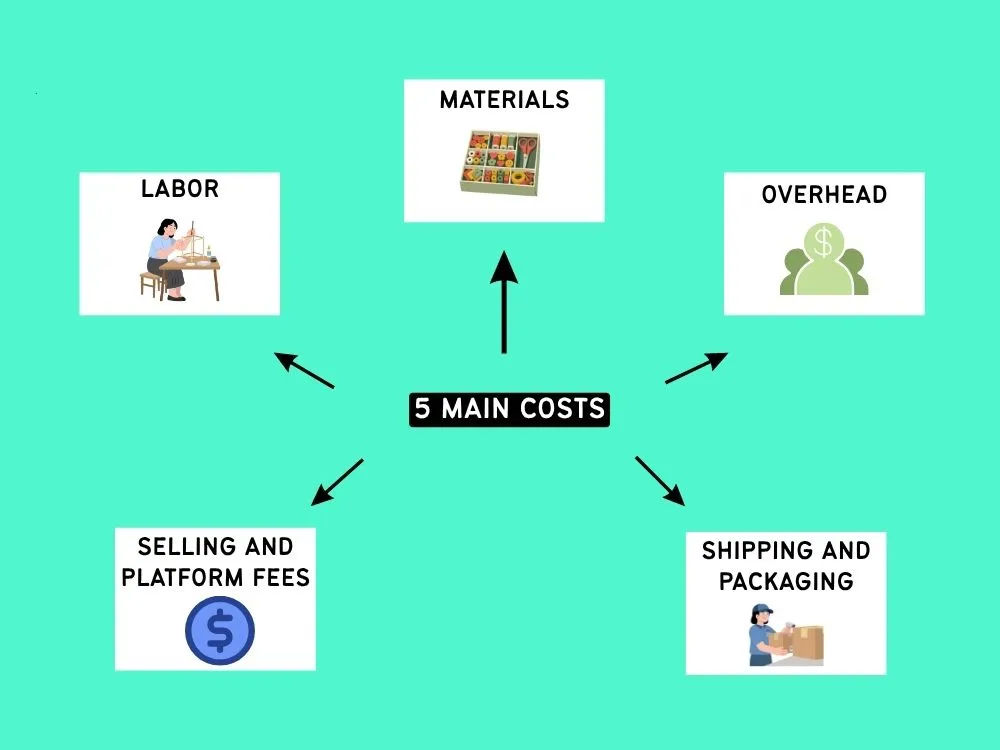
Here's the thing nobody tells you. Not every cost behaves the same way. Some costs scale with each item you make. Others get paid once for the whole batch, no matter how many pieces come out of it. Mixing these two up is where most profit calculations quietly fall apart.
Per-item cost
- Materials: Every time you make one more item, your material cost increases. Beads, wax, clay, fabric, whatever actually goes into the piece. Make one bracelet, spend $6. Make twenty-five, spend $150. It scales directly.
Batch costs (paid once, for the whole run)
- Labor: What you paid yourself, or someone else, to actually make the items. This is the cost people forget to count, and it's usually the biggest one hiding in plain sight.
- Overhead: These are running costs like vendor booth fees, that string of lights you bought for your table, packaging supplies you buy in bulk, the little studio costs that don't attach to any single item but keep the whole operation running.
- Selling and platform fees: Every platform you sell on wants a piece. For example, Etsy fees or marketplace commissions. Most crafters don't feel the pinch until they do the math at the end of the month and wonder where the money went.
- Shipping and packaging: Boxes, tape, mailers, postage. If you sell online, this is a real line item, not an afterthought. It adds up.
Let's make this concrete. Say you made 25 beaded bracelets for a weekend market:
- Materials: $6 per bracelet, so $150 total for 25
- Labor: you spent 10 hours making them and you're paying yourself $15 an hour, so $150
- Overhead: booth fee and packaging supplies came to $50
- Platform fees: your card reader took a small cut across all sales, $30 total
- Shipping: you sold a few online too, so $40 in shipping and mailers
Hold onto these numbers. We'll use them again in a second.
The Formula Behind the Numbers
Once you separate your costs like that, the actual formula is refreshingly simple:
| Total Revenue = Quantity Sold × Selling Price |
| Total Costs = (Materials × Quantity) + Labor + Overhead + Fees + Shipping |
| Net Profit = Total Revenue - Total Costs |
And two more numbers worth knowing:
- Profit Per Item = Net Profit ÷ Quantity Sold
- Profit Margin = (Net Profit ÷ Total Revenue) × 100
That's it. That's the whole formula. The math isn't hard. What's hard is actually sitting down and doing it, because most of us would rather just not know. But not knowing is exactly how you end up working weekends for less than minimum wage without realizing it.
Let's stop doing this in your head and just plug in real numbers.
Using our bracelet example: 25 items sold, $25 each, $6 in materials per bracelet, $150 in labor, $50 in overhead, $30 in fees, and $40 in shipping. Drop those numbers into the calculator below and watch your actual profit appear.
Try it with your own numbers too. Pull up your last market or your last week of online sales and run the real figures through. That's where this stops being theoretical and starts being useful.
What Your Results Are Actually Telling You
Okay, so you've got a number. Now what does it mean?
- Margin above 30%: That's healthy territory and it means you've got breathing room to reinvest in better materials, save a little, or just actually keep what you earned.
- Margin between 15% and 30%: Workable but you're not sitting pretty. A slow weekend or a sudden spike in material costs could put you in a tough spot pretty quick.
- Margin under 15%, or negative: This isn't a personal failure. It's just information. It means something in your setup needs to shift, and now you actually know that instead of just feeling worn out and vaguely broke without knowing why.
If your number is low, here's where to actually look:
- Raise your price: This is the one everybody sidesteps and the one that usually needs to happen the most. If your work is good and it probably is, people will pay for it. You're not being greedy. You're just finally charging what it's worth.
- Cut your material costs: Buying in bulk, trying a different supplier, or simplifying a design can knock real dollars off your cost without touching the quality of what you make.
- Speed up your process: If labor is swallowing your margin, look honestly at where your time actually goes. Sometimes one small change to how you work saves hours across an entire batch.
- Reconsider where you sell: If platform fees are quietly taking a big chunk of every sale, it might be worth trying a local market or a direct channel where more of that money actually stays with you.
None of these are shameful. They're just levers. Pull the one that makes sense for your situation.
Stop Pricing Your Time Like It's Free
Here's where I'm going to say the thing that might sting a little.
If someone offered a factory job paying $3 an hour? You'd laugh and walk away. But so many crafters do exactly that to themselves without realizing it. Paying themselves nothing or next to nothing, just to move product and feel productive.
Your time isn't a free ingredient. It's not the thing you throw in for free because the materials were the real cost. Your skill hours years of getting good at this, all count and are worth real money.
If your calculator is telling you your labor rate works out to $4 an hour, that's not a sign you need to work harder. It's a sign your price is wrong. You wouldn't accept that wage from anyone else. Don't accept it from yourself either.
Wrapping Up
You don't need to overhaul your whole business tonight. Just do this. Pick your three best-selling items, run each one through the calculator above with real numbers from your last few sales, and see what comes back.
Some of them might surprise you, in a good way. Some might tell you it's time for a price bump. Either way, you'll know. And knowing is the whole game here. You already make beautiful things. Now go make sure they're actually making you money too.
FAQs
Q1: How much profit margin should a craft business actually aim for?
Honestly, most sellers do best somewhere between 25% and 40%. Anything above is always nice but if you're hovering around 20% while you're still getting your footing, that's not a red flag either.
Q2: Should I pay myself an hourly rate even if I'm a one-person shop?
Absolutely, yes. If you skip labor costs, your profit is really just your unpaid wages in disguise. Pay yourself first, then see what's actually left over.
Q3: What's the difference between markup and profit margin?
Markup is what you add on top of your costs. Margin is what percentage of your final sale price you actually keep. They sound similar, but they're not the same math at all.
Q4: My materials cost keeps changing. How often should I recalculate profit?
Anytime you place a new supply order or notice prices ticking up, that's your cue. Even a small bump in your materials can eat into a margin that used to look just fine.
Explore Related Posts
https://smarttoolsai.com/post/dollar-tree-crafts-you-can-make-and-sell
https://smarttoolsai.com/post/calculate-sales-growth-percentage-using-a-percentage-calculator
https://smarttoolsai.com/post/multi-step-income-statement-a-practical-guide-for-financial-clarity