
How to Start a Virtual Assistant Business (Step by Step Guide)
.webp)
Want to know how people are making real money from home these days? Starting a virtual assistant business is blowing up right now. You don't need special certifications or thousands in startup costs.
Just solid organizational skills and the willingness to help businesses run more smoothly. Many people like this path because it gives the freedom that most jobs don't. You pick your hours and work from anywhere.
Companies are desperate for reliable help with scheduling, emails, data entry, and admin work. If you can stay organized and hit deadlines then you've got what it takes to make this work.
Key Takeaways
- Learn what virtual assistants do and why businesses are hiring them.
- Find out how to pick services and build a portfolio from scratch.
- Set your rates right and switch to monthly retainers fast.
- Get a step-by-step plan from setup to landing your first clients.
- Avoid mistakes that hurt your income or burn you out early.
What Does a Virtual Assistant Do?
Virtual assistants help businesses and individuals complete tasks when they don't have enough time to do everything themselves. VAs work remotely and keep things running smoothly.
Typical VA functions include:
- Email and calendar management
- Customer support and messages
- File organization
- Social media posting
- E-commerce support
- Project coordination
- Data entry and research
- Basic bookkeeping
You don’t need a degree or certification to become a VA. Your skills and communication matter far more.
Income Potential
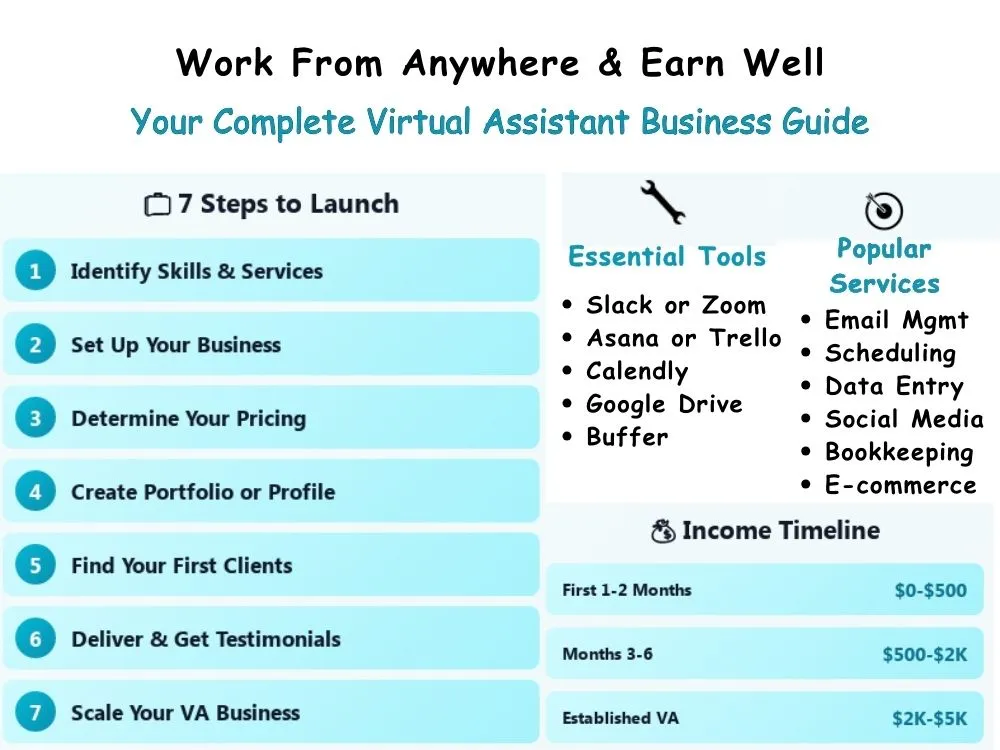
Let’s talk about the numbers. When you're just starting out, expect to make $0 to $500 in your first month or two. You're building your skills and landing those first clients.
Most VAs hit $500 to $2,000 per month once they have a few steady clients (By months 3 to 6). After that, if you stick with it and get good at what you do, $2,000 to $5,000+ per month is achievable.
Your income grows when you pick a niche, get faster at your work, and land retainer clients who pay you every month. However, keep in mind that your real earnings depend on many factors. These numbers are estimates, not guarantees.
Popular Virtual Assistant Services You Can Offer
You can start with simple admin work and slowly move into better pay like more than 5 figures per year and more specialized roles.
| Service | What You'll Do | Experience Needed | What You Can Charge |
|---|---|---|---|
| Email management | Sort emails, respond to messages, flag important stuff | Beginner | $15-$25/hour |
| Calendar scheduling | Book appointments, set reminders, coordinate meetings | Beginner | $15-$25/hour |
| Data entry | Update spreadsheets, organize files, input information | Beginner | $15-$25/hour |
| Customer support | Answer questions via email or chat, handle complaints | Beginner | $15-$30/hour |
| Social media posting | Schedule posts, write captions | Beginner | $15-$25/hour |
| Social media management | Create content, engage with followers, track results, | Intermediate | $25-$45/hour |
| Content writing | Write blog posts, edit drafts, upload content, update | Intermediate | $25-$50/hour |
| Bookkeeping | Track expenses, send invoices, basic accounting | Intermediate | $30-$50/hour |
| Project management | Track tasks, keep teams on schedule | Intermediate | $30-$50/hour |
| Podcast support | Edit episodes, write show notes, coordinate guests | Intermediate | $25-$45/hour |
| E-commerce support | Process orders, update products, help customers | Specialized | $30-$60/hour |
| Executive assistant | Handle everything for busy founders and executives | Specialized | $50-$100+/hour |
The beginner stuff gets you started and pays the bills. The specialized work is where you make real money once you know what you're doing.
Step 1: Identify Your Skills and Choose Your Services
First, you have to understand your skills and list your services based on that.
Think about:
- Jobs you've had before
- Volunteer work
- School or personal projects
- Personal tasks you handle easily
Start simple with general admin services like scheduling and data entry. They are easy to learn and have a good demand.
Once you gain enough confidence and real experience, you can move into:
- Social media management
- Podcast editing and show notes
- Real estate admin support
- E-commerce store management
- Bookkeeping
Step 2: Set Up Your Virtual Assistant Business
Forget about registering an LLC or getting business licenses right now. You can do that later when you're actually making money.
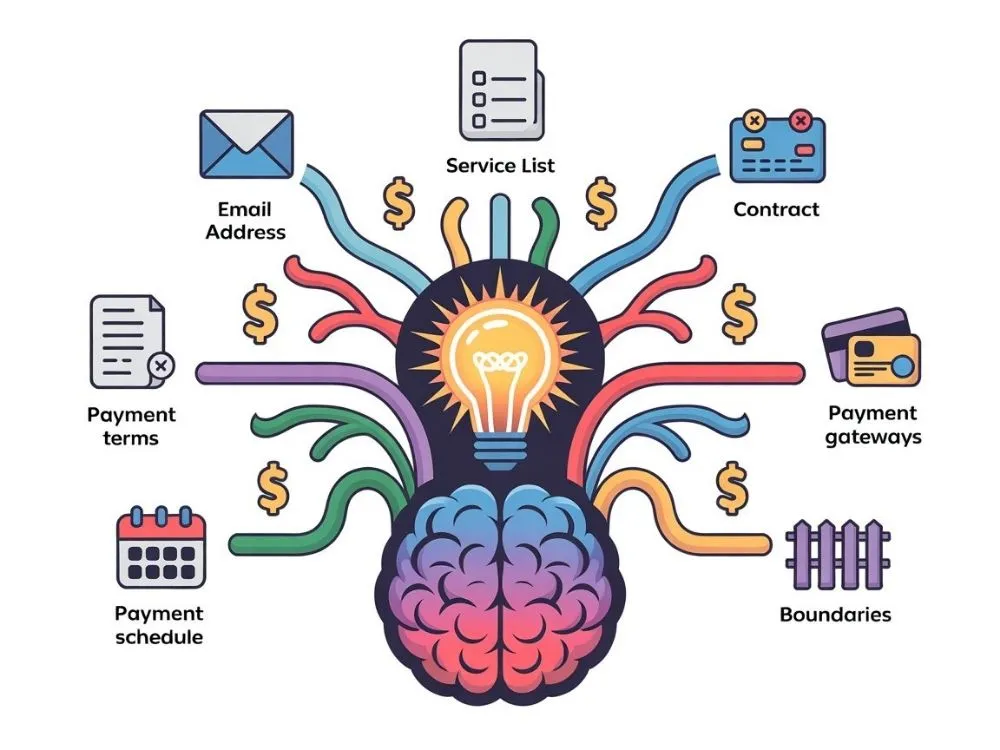
What you actually need to get started:
- A professional email address
- A simple service list
- A basic contract and payment terms
- A way to accept payments
Protect yourself from the beginning:
- Always get some money upfront. Even 30% helps weed out flaky clients.
- Be clear about your offers. People will ask for extra stuff if you don't set boundaries.
- Decide on your payment schedule like bi-weekly or monthly.
Tools you might need:
- Slack or Zoom for talking to clients
- Asana or Trello for tracking tasks
- Calendly for scheduling calls
- Google Drive for sharing files
- Buffer or Hootsuite if you're doing social media
Step 3: Determine Your Pricing
No need to overthink about pricing when you're starting out. Charge based on your experience:
- New to VA work: You can charge $15 to $25 per hour
- Got some clients under your belt: $25 to $50 per hour is ideal
- Specialized skills like bookkeeping or executive support: $50 to $100+ per hour
Monthly retainers are the way to go
Hourly work is fine at first, but switch to monthly packages as soon as you can. Offer something like:
- 10 hours per month
- 20 hours per month
- 30 hours per month
You get a steady income every month and don't have to hunt for new clients constantly. They know what they're paying, and you know what you're making. Way less stressful for everyone.
Flat fees for one-off projects
Some jobs don't need ongoing work. Inbox cleanups, website updates, or setting up a new system work better as flat-rate projects. Charge one price for the whole thing instead of tracking hours. Clients like knowing the final cost upfront.
Make sure you send invoices right away and follow up if the payment's late. Learn how to write a follow-up email to a client for payment to get paid on time without being pushy.
Step 4: Create Your VA Portfolio or Profile
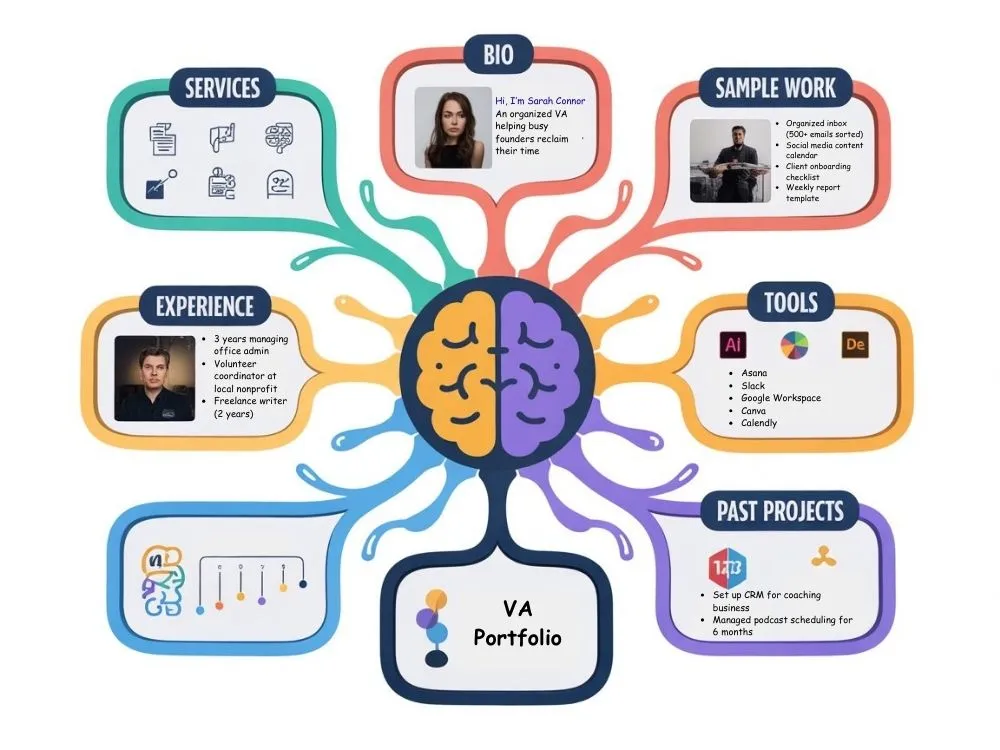
You don’t need a big website to start. Your portfolio should show:
- what services you offer
- tools you can use
- a short story about you
- sample work if possible
No clients yet? Make samples
If you haven't worked with anyone, create fake examples. It sounds weird but everyone does this when they're starting.
Make a sample organized inbox, draft some social media posts, or build a clean spreadsheet. Show you know how to do the work even if no one's paid you yet.
Use what you already have
Mention if you've got experience in other areas like graphic design, writing, managing documents or anything else. It shows you're organized and can handle real work.
Also, link to anything you've created before. This includes past projects or systems you've built. All count as proof that you can get things done. People hire VAs they trust. Your portfolio exists to show you're not gonna waste their time.
Step 5: Find Your First Clients
This is an inevitable part of your business. Below are the main places beginners use.
| Platform | Fees | Client Quality | Competition | Good for Beginners? |
|---|---|---|---|---|
| Upwork | 10% fee | Mixed | Very high | Yes |
| Fiverr | 20% fee | Low to medium | High | Yes |
| Belay | None for VAs | High | Medium | Some experience helps |
| Fancy Hands | None | Medium | Medium | Yes |
| Time Etc | None | High | Medium | Yes |
| None | High | Medium | Yes | |
| Direct outreach | None | High | Low | Yes |
Where most beginners start
Upwork and Fiverr are the easiest to get on. You can land jobs fast, but you're competing with hundreds of other VAs. Rates are usually lower too.
Where the real money is
LinkedIn and direct outreach take more effort. However, that's where you find clients who actually pay well and stick around.
Send short, helpful messages to business owners. Don't pitch right away. Offer something useful first and ask questions. Build real connections instead of spamming people with your services.
Step 6: Deliver Excellent Service and Get Testimonials
Your reputation matters a lot. One good testimonial beats a fancy resume every time.
Focus on basics:
- Reply to messages quickly
- Hit your deadlines (this is huge)
- Send updates without being asked
- Be honest about what you can and can't do
Ask for testimonials after every project
Ask for a review once you complete a project. Most of your clients will offer this if you ask. Say something like "Hey, would you mind leaving me a short testimonial? I'm building my portfolio and it would really help."
That's it. Those reviews make landing your next client way easier. Long-term clients come from being reliable, not from writing perfect proposals.
Step 7: Scale Your VA Business

Next, you have to think about leveling up once you've got a few steady clients and money coming in.
How to do it?
- Raise your rates if you're undercharging
- Pick a niche and get really good at it
- Move clients from hourly to monthly retainers
- Get better at managing your time
- Work with fewer clients who pay more
Don't burn yourself out
Set boundaries early. Working with five clients sounds great until you're answering emails at 10 PM every night. Block off time for each client. Turn off notifications after work hours. Say no to projects that don't fit your schedule.
Common Virtual Assistant Mistakes to Avoid
Many new VAs struggle because of simple mistakes. The most common ones you should avoid:
- Underpricing your work
- Saying yes to everything
- Working without contracts
- Not collecting payments upfront
- Ignoring time tracking
- Offering too many services at once
- Avoiding specialization
- Accepting unclear tasks
The biggest mistake? Treating this like you're doing someone a favor instead of running an actual business. You're not helping out. You're providing a service that's worth real money. Act like it from day one.
Wrapping Up
Starting a virtual assistant business is one of the most practical things. You need skills, perseverance, reliability, and strong communication. Start with simple services and build relationships. Then grow into higher-paying work over time. If you stay patient and reliable, this business can support you long term.
FAQs
Q1: What equipment do I need to start a virtual assistant business?
TBH, you don't need fancy equipment. Some basic tools are sufficient to start like a laptop, reliable Wi-Fi, furniture, and a clean workspace.
Q2: Do I need experience to become a VA?
Many people start without experience so you can too. Start with basic admin tasks you already know and learn as you go to scale this business further.
Q3: How much can I make as a beginner VA?
Most beginner VAs make between $15 to $25 per hour. However, many people hit $2k to $5k+ monthly with experience.
Explore Related Posts
https://smarttoolsai.com/post/create-and-sell-online-courses
https://smarttoolsai.com/post/how-to-start-affiliate-marketing-and-make-money