How to Start an Etsy Shop and Actually Make Money
.webp)
Excited to open an Etsy shop but not sure exactly how to do it? Honestly, many people feel the same way. However, it's not as hard as it sounds but requires some proper planning.
The tricky part isn't just setting up your shop. It's actually making money from it. A lot of sellers sign up and list a few items, then just wait around. That doesn't work on Etsy. You want a real strategy behind it.
So keep reading if you are serious about turning your shop into something profitable.
Key Takeaways
- Know everything about starting an Etsy shop without the guesswork.
- Find out how much it actually costs and when you can expect your first sale.
- Figure out what to sell and who to sell it to.
- Learn how to price your stuff so you actually make money.
- Avoid common mistakes that shut down most new Etsy sellers early on.
What is Etsy and Why Sell There?
Etsy is an online marketplace that connects people looking for handmade, custom, digital and vintage products. In other words, if someone is looking for something personal or customized, they look on Etsy.
So why sell there? You don’t have to build your own audience from nothing. People are already there on the platform, looking for things they don’t find on Amazon, Shopify, or any big retail sites. That alone makes it worth trying.
Plus, Etsy already has the trust factor. So buyers are more open to purchasing from you even if your shop is brand new. It's a good place to start before you think about building your own website.
What Sells Well on Etsy (And What Doesn't)
Before you open your Etsy shop, understand what actually sells and what doesn't. This helps avoid confusion and move on with clarity.
A) Best-Selling Product Categories
Some categories just do better than others on Etsy such as:
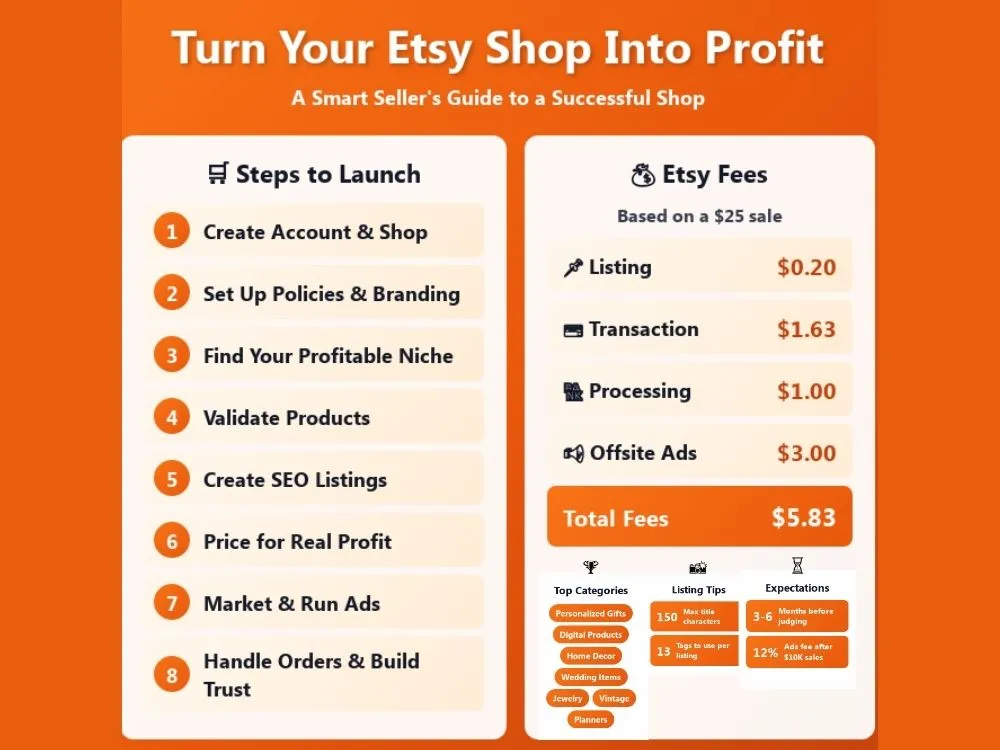
- Personalized gifts and custom items.
- Printable and digital products.
- Home decor and wall art.
- Wedding and event items.
- Jewelry and accessories.
- Vintage items (25+ years old).
- Planner inserts and templates.
Personalization is a vital thing on Etsy, where people love buying things made specifically for them.
B) Products to Avoid
Some products are very hard to sell on this platform such as:
- Generic mass-produced products.
- Items you can easily find on Amazon or Walmart.
- Trademarked or copyrighted products.
- Cheap, low-quality items.
- Popular categories without any unique spin.
If your product looks like something from a discount store, most Etsy buyers are gonna skip right past it. You need to stand out somehow, otherwise there is no reason for someone to pick your shop over someone else's.
How to Set Up Your Etsy Shop
A) Creating Your Account and Shop
Go to Etsy.com and create a free account. Then click on "Sell on Etsy" and follow the steps from there.
You will:
- Choose your shop name
- Set your language, country, and currency
- Add your first listing
- Set up payments and billing
Don't overthink your shop name at this point because you can always change it later.
B) Shop Policies and Branding
Your shop needs some basic policies to look professional. Etsy actually has policy templates you can customize. So you don't have to write them from scratch.
Make sure you have:
- A shipping policy
- A returns and exchanges policy
- A clear processing time
Also, add a simple banner and profile photo. Write a short About section explaining who you are and what you sell. Buyers tend to trust shops that look real and not empty. And make sure your payment method is set up through Etsy Payments since that is now required in most countries.
How Etsy Fees Actually Work
Etsy fees are pretty straightforward, but a lot of beginners forget to account for all of them when pricing their products.
There are four main types of fees.
- First, you pay a listing fee of $0.20 for each product you publish. This listing stays active for four months.
- Second, Etsy takes a transaction fee every time you make a sale.
- Third, there is a payment processing fee for handling the payment.
- Fourth, offsite ads fees may come into play if Etsy promotes your product outside the platform.
Here is how it looks in real numbers.
Fee Type | Amount | Example on $25 Sale |
|---|---|---|
| Listing fee | $0.20 per listing | $0.20 |
| Transaction fee | 6.5% of item price + shipping | $1.63 |
| Payment processing | About 3% + $0.25 | $1.00 |
| Offsite ads (if applied) | 12% or 15% | $3.00 |
| Total fees | $5.83 |
A couple of things to keep in mind. Fees apply to both the item price and shipping. So don't forget to factor that in. Also, the off-site ads fee drops from 15% to 12% once your shop reaches $10,000 in annual sales.
Choose What to Sell
A) Finding Your Niche
A niche is basically a focused group of buyers. Instead of selling general wall decoration art, you could narrow it down to something like:
- Pet memorial art
- Nursery wall prints
- Fitness quote posters
The more specific you get, the easier it is to stand out. Find niches where buyers have an emotional connection. Gifts, celebrations, and personal moments like birthdays tend to do really well on Etsy.
B) Validating Your Products
Before you start creating anything, search Etsy for your product idea first.
Check:
- How many results show up
- How many shops actually have sales
- Whether listings look active
- Products that have the "Best Seller" badge
Some competition is actually a good thing. It means people are already buying. Read reviews on similar products too. They will tell you what buyers love and what they complain about.
You can also use free tools like eRank or Marmalead to check search volume for your product ideas. They take a lot of the guesswork out of picking the right niche.
Create Listings That Actually Sell
Your listing does most of the heavy lifting for you. So getting it right matters.
A) Writing Titles and Descriptions for Etsy SEO
Your title should clearly describe what the product is. The recommended title length is below 150 characters.
Include:
- Main product keyword
- Personalization type
- Occasion if relevant
Your description should:
- Explain what the product is
- Who it is for
- How customization works
- What the buyer actually receives
Write like you are answering a customer question. That's basically what you are doing. Don't forget about tags either. You get 13 tags per listing and they play a big role in how people find your products. A lot of new sellers skip them, which is a mistake.
B) Photography Tips for Product Listings
Photos matter more than almost anything else on Etsy. Buyers can't touch your product, so your photos have to do that job.
Use:
- Bright natural lighting
- Clean backgrounds
- Close-up shots
- Lifestyle images when possible
Show image size and scale clearly. And don't worry if you don't have a fancy camera. A smartphone works perfectly fine as long as your lighting is good.
Price Your Products for Profit
Pricing is key and at the same time seems confusing for new sellers. Either way, you have to consider the costs and still you wanna walk away with some profit. It looks like this:
Selling Price = Product Cost + Packaging + Etsy Fees + Your Time + Profit
Here is how that breaks down with real examples.
| Product | Cost to Make | Packaging | Etsy Fees | Selling Price | Profit |
|---|---|---|---|---|---|
| Printable wall art | $1.00 | $0 | $1.50 | $8.00 | $5.50 |
| Custom mug | $9.00 | $1.50 | $3.50 | $22.00 | $8.00 |
| Handmade bracelet | $5.00 | $1.00 | $2.50 | $18.00 | $9.50 |
| Personalized gift box | $7.00 | $2.00 | $3.00 | $24.00 | $12.00 |
| Digital planner template | $0.50 | $0 | $1.20 | $12.00 | $10.30 |
A couple of things to keep in mind. Don't just look at what other sellers are charging and copy their price. That doesn’t always work because you don't know their actual costs. Price based on your real numbers and make sure your time is worth something too.
Market Your Etsy Shop
Etsy SEO is the first thing to consider. I mean strong titles, descriptions, tags, and categories help Etsy show your products to the right buyers. But don't stop there.
Social media can do a lot of the heavy lifting too. Pinterest is especially good for home decor and printables. It actually works more like a search engine than a regular social platform. So people are actively looking for ideas there.
Post behind the scenes content, finished products, customer reactions, etc. You don't need to go viral. You just need steady traffic coming in.
If you want to speed things up a bit, Etsy also has its own ads feature. It's a good way to test what sells before you put too much time into organic marketing. Just don't spend too much on it early on until you know what works.
Handle Orders and Customer Service
Many buyers ask questions before placing an order. So reply to messages quickly. Always confirm customization details before starting production.
Moreover, send shipping updates when possible to let buyers know about any delays. Mistakes happen but honest communication protects your reviews. These good reviews help your listings rank higher and increase buyer trust.
Common Etsy Mistakes to Avoid
A lot of sellers open a shop and then just wait for traffic to show up. That is not how Etsy works. You still need strong listings and some marketing behind it. Avoid these common mistakes:
- Copying popular designs.
- Ignoring copyright rules.
- Using poor photos.
- Forgetting to include fees when pricing.
- Offering unclear customization instructions.
- Ignoring customer feedback and reviews.
Another big one is giving up too early. A lot of new sellers quit after one month when things are slow. Etsy shops usually take some time to build up, so patience matters here.
Wrapping Up
Etsy won't make you rich overnight, but it can become a real source of income if you do it right. The key is not just opening a shop. It's putting in the work behind it. Pick something you enjoy and stay patient. Give yourself at least 3-6 months before you judge whether it's working or not.
FAQs
Q1: How long does it take to make my first sale?
Some people get a sale within days. Some take a few months. It all depends on your niche and how you market it. Just stay consistent and don't panic early on.
Q2: Can I sell on Etsy without any experience?
Yeah you can. Most sellers learn as they go. Nobody figures it all out on day one. Just start and test things which helps adjust based on what works.
Q3: Is Etsy too saturated? Is it too late to start?
People say this about every online business. TBH, there's competition. But new niches pop up all the time where you just have to find the right one for you.
Explore Related Posts
https://smarttoolsai.com/post/how-to-start-a-print-on-demand-business